
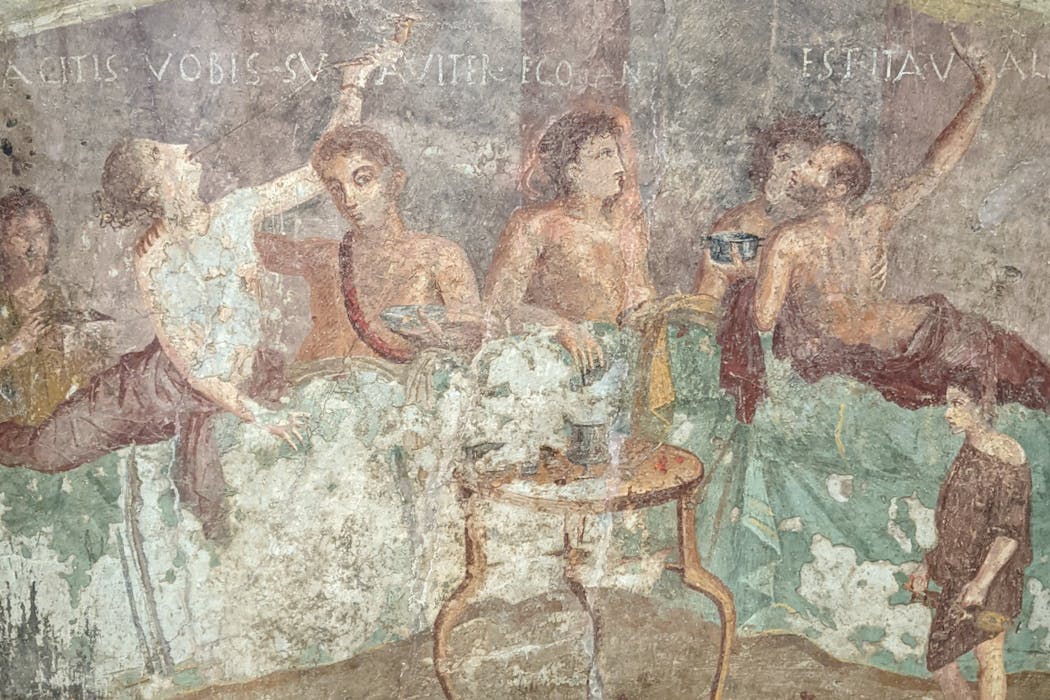
Just like in the modern world, people in ancient times wanted to know how to live a long and healthy life.
Greeks and Romans heard fantastic tales of far-away peoples living to well beyond 100.
Greek essayist Lucian (about 120–180 CE) writes:
Indeed, there are even whole nations that are very long-lived, like the Seres [Chinese], who are said to live 300 years: some attribute their old age to the climate, others to the soil and still others to their diet, for they say that this entire nation drinks nothing but water. The people of Athos are also said to live 130 years, and it is reported that the Chaldeans live more than 100, using barley bread to preserve the sharpness of their eyesight.

Whatever the truth of these tales, many ancient Greeks and Romans wanted a long and healthy life.
This is how they thought this could happen.
An ancient doctor’s perspective
Ancient doctors were interested in what people who lived long lives were doing every day and how this might have helped.
The Greek physician Galen (129–216 CE), for example, discusses two people he knew personally in Rome who lived to old age.
First, there is a grammarian (someone who studies and teaches grammar) called Telephus, who lived to almost 100.
According to Galen, Telephus ate just three times a day. His diet was simple:
gruel boiled in water mixed with raw honey of the best quality, and this alone was enough for him at the first meal. He also dined at the seventh hour or a little sooner, taking vegetables first and next tasting fish or birds. In the evening, he used to eat only bread, moistened in wine that had been mixed.
Galen also tells us Telephus had some bathing habits that might seem unusual to us today. Telephus preferred to be massaged with olive oil every day and only have a bath a few times a month:
He was in the habit of bathing twice a month in winter and four times a month in summer. In the seasons between these, he bathed three times a month. On the days he didn’t bathe, he was anointed around the third hour with a brief massage.
Second, there was an old doctor named Antiochus, who lived into his 80s.
According to Galen, Antiochus also had a simple diet.
In the morning, Antiochus usually ate toasted bread with honey. Then, at lunch, he would eat fish, but usually only fish “from around the rocks and those from the deep sea”. For dinner, he would eat “either gruel with oxymel [a mix of vinegar and honey] or a bird with a simple sauce”.
Alongside this simple diet, Antiochus went for a walk every morning. He also liked to be driven in a chariot, or had his slaves carry him in a chair around the city.
Galen also said Antiochus “performed the exercises suitable for an old man”:
There is one thing you should do for old people in the early morning as an exercise: after massage with oil, next get them to walk about and carry out passive exercises without becoming fatigued, taking into account the capacity of the old person.
Galen concludes that Antiochus’ routine probably contributed to his good health well into advanced age:
Looking after himself in old age in this way, Antiochus continued on until the very end, unimpaired in his senses and sound in all his limbs.
Galen stresses that Telephus and Antiochus had some obvious things in common. They ate just a few times a day; their diet was of wild meats, whole grains, bread and honey; and they kept active every day.

What can you do?
Not all of us can live to 100 or more, as the Greeks and Romans were well aware.
However, Lucian offers us some consolation in his essay On Octogenarians:
On every soil and in every climate people who observe the proper exercise and the diet most suitable for health have been long-lived.
Lucian advised that we should imitate the lifestyles of people who have lived long and healthy lives if we want to do the same.
So, if you lived in Rome in the 2nd century CE, people like Telephus and Antiochus, who had a simple diet and kept active all their lives, would be good role models.

Konstantine Panegyres does not work for, consult, own shares in or receive funding from any company or organisation that would benefit from this article, and has disclosed no relevant affiliations beyond their academic appointment.
* This article was originally published at The Conversation


.jpg)


0 Comments