
For as long as you have been a member of your local gym, you have used a small plastic tag to access it. But now the tag no longer works. Instead, you have to download an app to get inside for your workout – and that app requires location access and Bluetooth access, which would allow it to track your location within the gym, and potentially anywhere based on the Bluetooth signal.
This is just one example of being forced to use apps where we otherwise might not want to. It happens if we want to communicate with government, to engage with health services, to authenticate our identities, and so much more.
In many ways, this is a consequence of the very success of mobile apps: they have become handy tools for a litany of everyday tasks, and an indispensable part of life. And while it might seem innocuous, this proliferation of apps comes with several hidden problems. So what’s driving it? And how can it be fixed?
A rapid growth
The Apple App Store launched in July 2008 with 500 apps. It had 50,000 by the end of its first year. By 2013, it had roughly one million. It now has more than 2.5 million gaming and non-gaming apps.
The early Android Market (later Google Play) launched in 2009 with 2,300 apps, exploding to 500,000 by late 2011, and 1 million by 2013 – just as the App Store did. It now has nearly 3 million gaming and non-gaming apps.
In the early days of app-enabled mobile phones, developing an app was expensive and time consuming, so there had to be both a clear business case and consumer need.
These days though, app construction platforms and “vibe coding” – getting generative artificial intelligence to write computer code – help absolute novices create a convincing app for many purposes in hours, feeding the rapid growth of apps.
Governments, gyms, banks, insurers and airline loyalty programs also insist you use their app for access to some services.
This appeals to organisations because it allows them to potentially collect more personal data, such as your location. This data can be monetised if the company chooses.
Another reason behind this trend is the fact that a phone is now a primary source of identity. Providing a “digital card” for scanning, instead of physical membership cards and electronic tags, also saves companies considerable time and resources.
Taking up valuable space
The vast array of app choice makes it very difficult, especially on a tiny mobile screen, to determine which app is best for your unique needs, and whether any of them are worth paying for.
This is especially true if you are looking for “a good health app” or “a fun game” or “a useful travel app” – or any similar situation where there are hundreds of apps that could fit the bill.
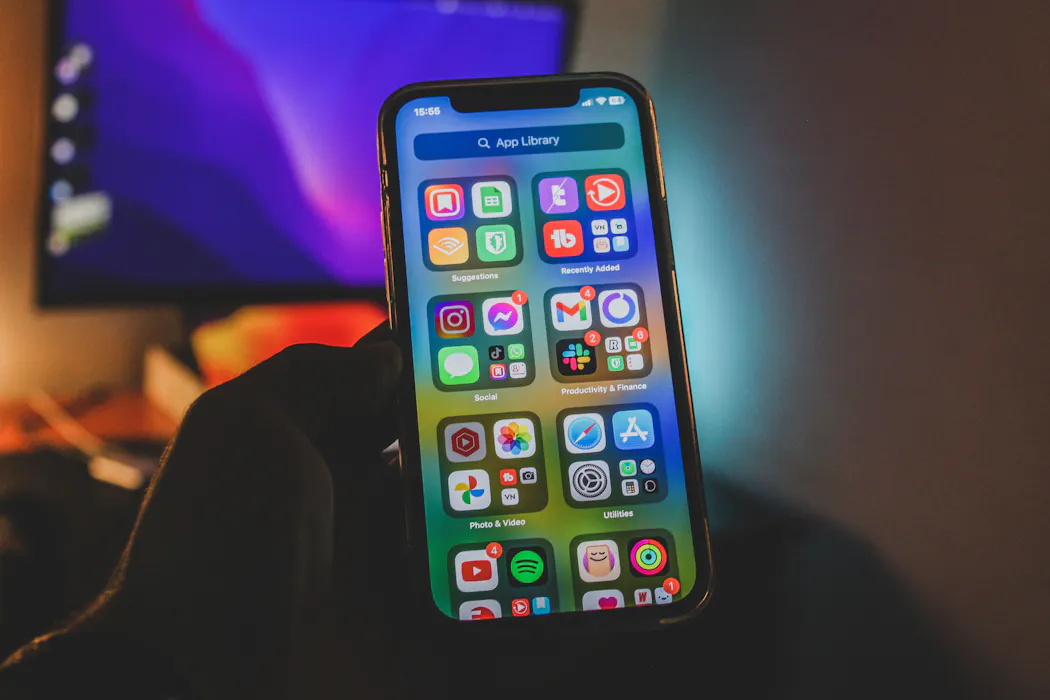
On top of this, it’s easy to end up with dozens of seldom-used apps on our phone.
We may, for example, be forced to download an app to access a public locker at a library, which we only use once. This not only clutters our screen and creates problems finding the app we need; it also takes up valuable memory space on your device.
Finally, each of these apps may collect data, nudge for our attention, or drain the battery life of our phone.
App stores need to step up
This is a problem app stores can partially solve by supporting a more fine-grained discovery approach.
These stores could allow us to filter apps by rating, by payment mechanism, or by features – for example, what permissions an app requires, or what kinds of activity you can log with a fitness app.
They could also require clearer descriptions of apps and their battery use, permissions, and monetisation mechanisms that will then allow us to make more informed decisions.
The simple page-based horizontal scrolling mechanism on modern phones that has worked so well is crumbling under the number of apps we typically have now, especially as they rebrand or change icons.
Alternative arrangements, such as “piles” or groups, may really help here – as would nudges to remove apps we’re no longer using.
Until the app stores choose to help us, it might be up to us to help ourselves, curating apps and deleting what we don’t need – giving us back space on our screens, in our minds, and in our lives.

Dana McKay has received funding from the Australian Research Council and the National Health and Medical Research Council. She received funding from Google in 2016 during her PhD, and had a secondment to Nokia Research Centre in Helsinki, Finland, a part of Nokia Mobile Phones in 2002.
George Buchanan does not work for, consult, own shares in or receive funding from any company or organisation that would benefit from this article, and has disclosed no relevant affiliations beyond their academic appointment.
* This article was originally published at The Conversation


0 Comments