
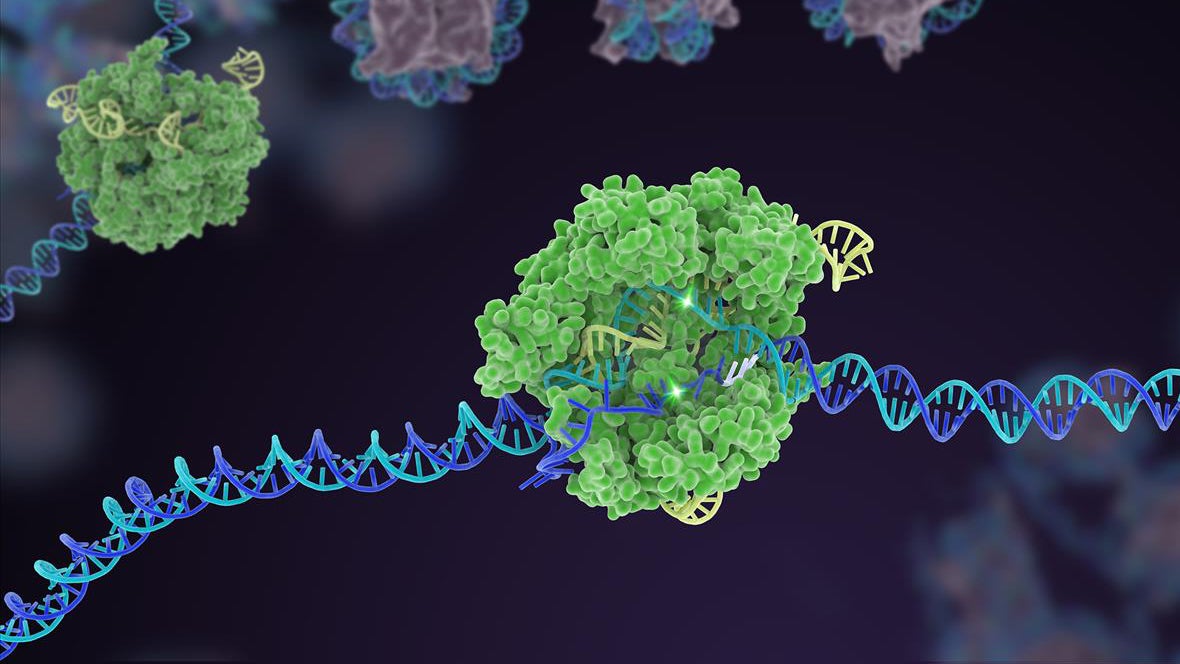
The self-spreading CRISPR tool increased editing efficiency roughly three-fold compared to older versions.
Gene editing is a numbers game. For any genetic tweaks to have notable impact, a sufficient number of targeted cells need to have the disease-causing gene deleted or replaced.
Despite a growing gene-editing arsenal, the tools share a common shortcoming: They only work once in whatever cells they reach. Viruses, in contrast, readily self-replicate by hijacking their host’s cellular machinery and then, their numbers swelling, drift to infect more cells.
This strategy inspired a team at the University of California, Berkeley and collaborators to modify the gene editor, CRISPR-Cas9, to similarly replicate and spread to surrounding cells.
Led by gene-editing pioneer and Nobel Prize winner, Jennifer Doudna, the scientists added genetic instructions for cells to make a virus-like transporter that can encapsulate the CRISPR machinery. Once manufactured in treated cells, the CRISPR cargo ships to neighboring cells.
The upgraded editor was roughly three times more effective at gene editing lab-grown cells compared to standard CRISPR. It also lowered the amount of a harmful protein in mice with a genetic metabolic disorder, while the original version had little effect at the same dose.
The technology is “a conceptual shift in the delivery of therapeutic cargo,” wrote the team in a bioRxiv preprint.
Recoding Genetics
CRISPR has completely transformed gene therapy. In just a few years, the technology exploded from a research curiosity into a biotechnology toolbox that can tackle previously untreatable inherited diseases. Some CRISPR versions delete or inactivate pathogenic genes. Others swap out single mutated DNA letters to restore health.
The first CRISPR therapies focus on blood disorders and require doctors to remove cells from the body for treatment. The therapies are tailored to each patient but are slow and costly. To bring gene therapy to the masses, scientists are developing gene editors that edit DNA directly inside the body with a single injection.
From reprogramming faulty blood cells and treating multiple blood disorders to lowering dangerous levels of cholesterol and tackling mitochondrial diseases, CRISPR has already proven it has the potential to unleash a new universe of gene therapies at breakneck speed.
Gene editors “promise to revolutionize medicine by overriding or correcting the underlying genetic basis of disease,” wrote the team. But all these tools are throttled by one basic requirement: Enough cells have to be edited that they override their diseased counterparts.
How many depends on the genetic disorder. Treatments need to correct around 20 percent of blood stem cells to keep sickle cell disease at bay. For Duchenne muscular dystrophy, an inherited disease that weakens muscles, over 15 percent of targeted cells need to be edited.
These numbers may seem low, but they’re still challenging for current CRISPR technologies.
“Once delivered to cells, editing machinery is confined to the cells it initially enters,” wrote the team. To compensate, scientists often increase the dosage, but this risks triggering immune attacks and off-target genetic edits.
Work Smarter, Not Harder
Although membrane-bound and seemingly isolated, cells are actually quite chatty.
Some cells package mRNA molecules into bubbles and eject them towards their neighbors, essentially sharing instructions for how to make proteins. Other cells, including neurons, form extensive nanotube networks that shuttle components between cells, such as energy-producing mitochondria.
Inspired by these mechanisms, scientists have transferred small proteins and RNA across cells. So, the team thought, why couldn’t a similar mechanism spread CRISPR too?
The team adapted a carrier developed a few years back from virus proteins. The proteins automatically form a hollow shell that buds off from cells, drifts across to neighboring cells, and fuses with them to release encapsulated cargo.
The system, called NANoparticle-Induced Transfer of Enzyme, or NANITE, combines genetic instructions for the carrier molecules and CRISPR machinery into a single circular piece of DNA. This ensures the Cas9 enzyme is physically linked to the delivery proteins as both are being made inside a cell. It also means the final delivery vehicle encapsulates guide RNA as well, the “bloodhound” that tethers Cas9 to its DNA target.
Like a benevolent virus, NANITE initially “infects” a small number of cells. Once inside, it instructs each cell to make the full CRISPR tool, package it up, and send it along to other cells. Uninfected cells absorb the cargo and are dosed with the gene editor, allowing it to spread beyond treated cells.
Compared to classic CRISPR-Cas9, NANITE was roughly three times more efficient at editing multiple types of cells grown in culture. Adding protein “hooks” helped NANITE locate and latch on to specific populations of cells with a matching “eye” protein, increasing editing specificity. NANITE punched far beyond its weight: Edited cells averaged nearly 300 percent of the initially treated number, suggesting the therapy had spread to untreated neighbors.
In another test, the team tailored NANITE to slash a disease-causing protein called transthyretin in the livers of mice. Mutations to the protein eventually lead to heart and nerve failure and can be deadly. The researchers injected NANITE directly into the rodents’ veins using a high-pressure system. This technique reliably sends circular DNA to the liver, the target organ for the disease, and shows promise in people.
Within a week, NANITE had reduced transthyretin nearly 50 percent while editing only around 11 percent of liver cells. Such results would likely improve and stabilize the disease according to previous clinical trials, although the team did not report symptoms. In contrast, classic CRISPR-Cas9 only edited four percent of cells and had minimal effect on transthyretin production.
The failure could be because the gene editor was confined to a small group of cells, whereas NANITE spread to others, “enabling more efficient tissue-level editing,” wrote the team. Extensive liver and blood tests in mice treated with NANITE detected no toxic side effects.
A three-fold boost in editing is just the beginning. The team is working to increase NANITE efficacy and to potentially convert the system into mRNA, similar to the technology underlying Covid-19 vaccines. Compared to shuttling circular DNA into the body—a long-standing headache—there is a far wider range of established delivery systems for mRNA.
Still, these early results suggest it’s possible to “amplify therapeutic effects by spreading cargo” beyond the initially edited cells. Avoiding the need for relatively large doses, NANITE could increase the safety profile of gene-editing treatments and potentially expand the technology to tissues and organs that are more challenging to genetically alter than the liver.
The technology changes the numbers game. Even if only a fraction of the NANITE therapy reaches its target tissue, its ability to spread could still deliver enough impact to cure currently untouchable genetic diseases. “By lowering effective dose requirements, NANITE could make genome editing more practical and accessible for treating human disease,” wrote the team.
The post Souped-Up CRISPR Gene Editor Replicates and Spreads Like a Virus appeared first on SingularityHub.
* This article was originally published at Singularity Hub


2 Comments
LSPatch is a remarkable website that delivers functionality with ease. I love its clean layout, fast performance, and practical tools. The site makes difficult processes much more manageable, and I genuinely appreciate the developers’ commitment to quality and user experience.
ReplyDeleteI love using IPTVnator for all my streaming needs. The website is easy to navigate, channels are high-quality, and performance is consistent. Their dedication to providing a smooth and reliable experience is clearly evident.
ReplyDelete